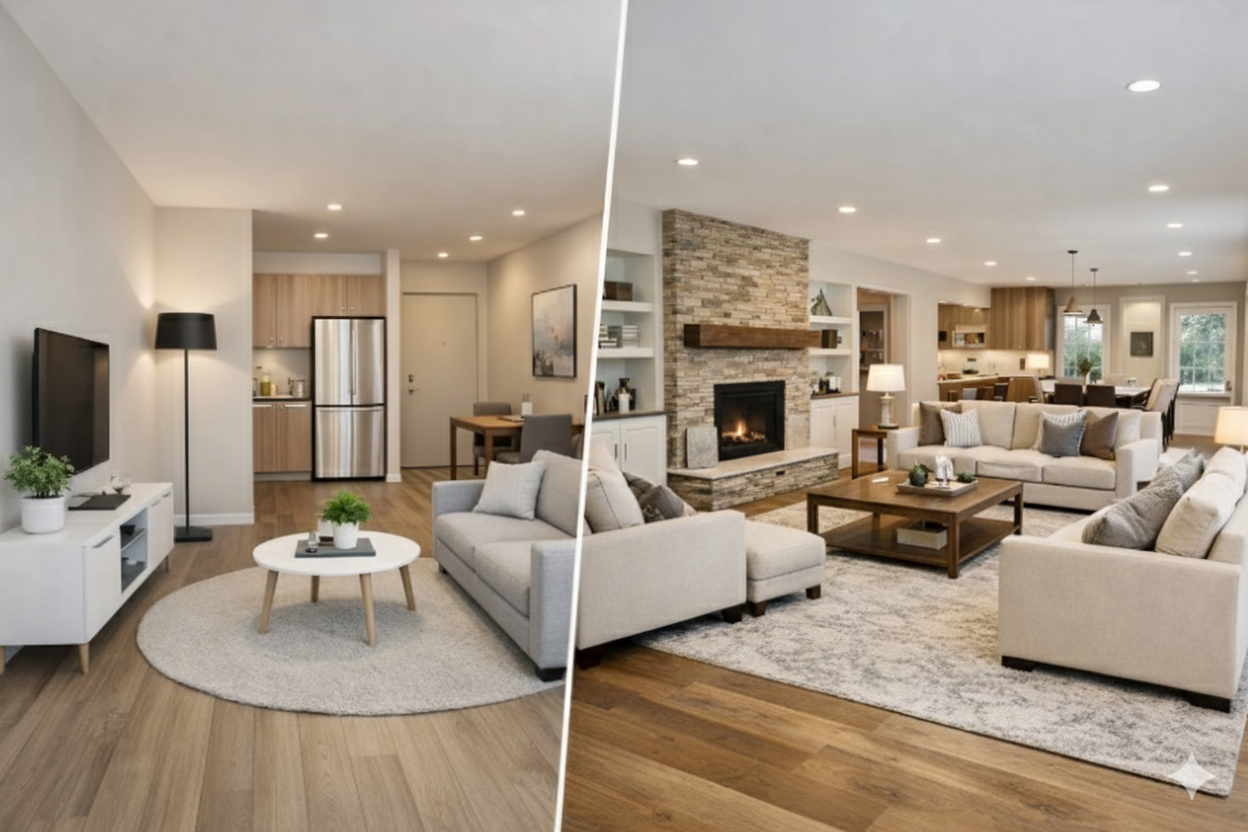
In the United States real estate market, online presentation plays a measurable role in how listings attract attention and convert interest into showings. Data published by the National Association of Realtors shows that about 97% of homebuyers begin their property search online, where listing photos become the first decision filter. The same report indicates that 41% of buyers are more willing to schedule an in-person visit when a property appears staged in listing images. These numbers explain why visual accuracy and spatial communication matter at the listing stage.
Virtual staging for apartments vs houses requires different thinking at the planning stage. Variations in layout, room size, buyer behavior, and expected occupancy change how spaces should be presented. Applying the same visual solution across both often misreads the space. Technically sound staging supports realistic perception and fits how U.S. audiences review listings online.
Also Read: Virtual Staging
What Virtual Staging Means in Modern Real Estate Listings
In U.S. listings, virtual staging is simply a way to help people understand space before they see it in person. The photos are real. The walls, windows, and room sizes stay exactly as they are. Furniture is added digitally so viewers can judge how a room actually works. Empty rooms look confusing online. Buyers struggle to tell where a bed fits or how much walking space remains. That problem shows up every day in MLS browsing behavior. Virtual staging is used to remove that friction. It is built for online decision-making, not for design display.
Most buyers scroll fast and shortlist quickly, which makes clarity more important than style. When comparing virtual staging for apartments vs houses, the meaning stays the same, but the application does not. Apartments demand strict scale control. Houses require clearer separation between rooms. The value comes from making the layout readable, while decoration remains secondary.
Also Read: Virtual Staging for MLS Listings: What to Know
Apartment Versus House Marketing Priorities
How the Property Is Meant to Be Used
Apartment listings focus on how the unit functions right now. Most viewers are not thinking about future changes at this stage. Storage, furniture fit, and walking room matter early. Houses are viewed through a longer lens. Buyers think about how the space will hold up over time, not just how it works today.
How Quickly Decisions Are Made
Apartment listings move fast. Viewers scroll, compare, and eliminate options in a short window. If the layout is not obvious, the listing often gets skipped. Houses follow a slower pattern. Buyers come back to the same listing more than once and study room relationships before making contact.
What Viewers Look for in the Layout
Apartment shoppers focus on efficiency. They want to see that nothing feels wasted or cramped. House buyers read layout differently. They pay attention to the separation between rooms, hallway flow, stair placement, and how spaces connect across levels.
Also Read: How Much Does Virtual Staging Cost in the USA?
How Much Visual Explanation Is Needed
Apartments usually rely on a limited number of images. A few clear rooms can explain most of the unit. Houses need more coverage. Multiple bedrooms, shared spaces, and secondary areas must be shown to avoid confusion.
Practical Thinking Versus Future Projection
Apartment marketing stays grounded. The question is simple: will this work for me right now. House marketing invites projection. Buyers imagine routines, guests, and changes over time. That difference drives how staging decisions are made.
Virtual Staging for Apartments
Dealing With Smaller, Tighter Layouts
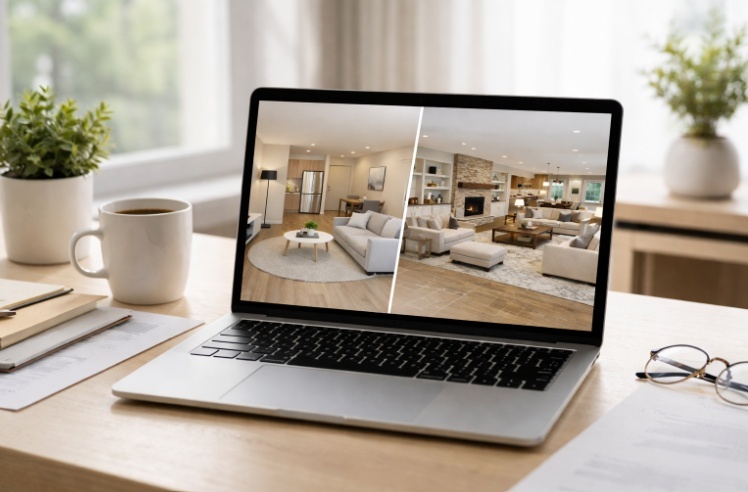
Most apartments do not give much margin for error. Rooms are compact and every wall matters. Virtual staging is used here to make the layout readable, not impressive. Viewers want to understand where furniture fits and how much open space remains once it is placed.
Also Read: What Are the Best Ceiling Color Ideas for the Living Room?
Keeping Furniture Proportions Honest
Scale problems stand out quickly in apartments. A couch that looks too deep or a bed that feels oversized can immediately make the unit seem unusable. Virtual staging for apartments sticks to furniture sizes that reflect what would realistically be purchased and delivered into the space.
Showing How One Room Serves Multiple Uses
Apartments frequently combine living, dining, and work areas into a single room. Virtual staging helps separate these uses visually without walls. Furniture placement and orientation do most of the work. Nothing decorative is added unless it helps explain the function.
Focusing on Everyday Activities
Apartment viewers think about routine first. Where do they sleep? Where they sit. Where they work. Virtual staging highlights these basics clearly, so the space feels understandable within seconds of viewing the image.
Limiting the Number of Staged Images
Apartment listings rarely need full coverage. Staging usually focuses on the main living area and bedroom. Additional rooms are staged only when they clarify the layout or solve confusion.
Avoiding Personal Design Signals
Apartments are marketed to a wide audience. Virtual staging avoids strong style choices that narrow appeal. Neutral setups make it easier for viewers to imagine themselves in the space.
Also Read: Can I Pay Someone to Virtually Stage My Room
Virtual Staging for Houses
Understanding How Rooms Connect
Houses give more room, but that space creates its own problems online. Buyers struggle to understand how rooms relate to each other when they only see isolated photos. Virtual staging is used to show the connection. A living room needs to feel tied to the dining area. Hallways and transitions need context, even if they are not staged themselves.
Giving Each Room a Clear Role
Most houses have rooms that are meant to do specific jobs. Buyers expect that clarity. Virtual staging reinforces purpose. Dining rooms look like dining rooms. Spare rooms are shown as offices or guest spaces so buyers know where they fit into the overall layout.
Fixing the Scale Problem
Empty houses photograph poorly. Rooms look larger than they feel in person, which can create unrealistic expectations. Virtual staging adds furniture back in so buyers can judge distance, walking space, and proportion. The furniture is not there to decorate. It is there to correct the scale.
Thinking Beyond Move-In Day
House buyers plan ahead. They think about family size, storage, and how rooms may change over time. Virtual staging reflects that mindset by showing spaces that feel flexible without forcing a lifestyle story.
Also Read: Does Virtual Staging Help Sell a House? A Clear Look at the Data
Showing More of the Property
House listings need more visual explanation. Buyers notice when rooms are missing. Virtual staging usually covers living areas, bedrooms, and secondary rooms that influence layout understanding.
Allowing Limited Lifestyle Signals
Some lifestyle cues are acceptable in houses. A dining table or outdoor seating helps buyers imagine use. These elements stay subtle and realistic.
Within virtual staging for apartments vs houses, houses require explanation across rooms, not just furniture placement inside them.
Also Read: Staging Closets for Home Sale
Design Approach Differences in Virtual Staging
Starting From the Structure, Not the Style
Design decisions in virtual staging usually begin with the structure of the property, not with aesthetics. Apartments and houses respond differently to the same design choices because the underlying layouts behave differently on screen. A style that works in a wide living room can distort perception in a narrow one.
Color Use and Visual Weight
Apartments benefit from lighter visual weight. Dark furniture or heavy textures can make rooms feel tighter than they are. Virtual staging keeps contrast controlled so walls and walkways remain readable. Houses allow slightly more variation. Larger rooms can absorb darker tones without shrinking visually, but contrast still needs restraint.
Furniture Density and Spacing
Apartment layouts react quickly to furniture placement. When pieces sit too close together, the room can feel smaller than it is. Virtual staging keeps spacing loose. Houses offer more flexibility, allowing furniture to sit farther apart while still feeling intentional.
Decorative Elements and Restraint
Decor plays a limited role in both property types, but for different reasons. In apartments, decor is minimized to avoid distraction. In houses, decor is reduced to avoid over storytelling. In both cases, decoration is secondary to clarity.
Lighting Consistency
Virtual lighting adjustments are subtle. Apartments rely on even lighting to prevent shadows from compressing space. Houses use lighting to maintain continuity between rooms rather than create mood shifts.
Also Read: Entryway Staging Ideas
Common Virtual Staging Errors to Avoid
Placing furniture that clearly would not fit in real life, which makes buyers question everything else in the image.
Letting digital pieces block doors, windows, or walk paths, even slightly, since viewers notice this quickly.
Adding too many items in small rooms, especially apartments, where clutter kills spatial understanding.
Leaving large house rooms almost empty, which creates false expectations about the size once seen in person.
Switching furniture styles from room to room without reason makes the home feel inconsistent and poorly planned.
Ignore fixed elements like vents, radiators, or built-in shelving when positioning staged items.
When digitally staged photos are not clearly identified, trust breaks down quickly and issues follow.
Conclusion: Getting Virtual Staging for Apartments vs Houses Right
Virtual staging only works when it respects how people actually read listings. Apartments are judged fast. Viewers want to know, almost immediately, whether the space fits daily life without adjustment. Houses invite slower review. Buyers study room connections, scale, and how the home might function years down the line. Applying the same staging logic to both creates confusion instead of clarity. When staging decisions are tied to property type, listings feel more honest and easier to evaluate. That clarity matters because most decisions are made before a showing ever happens. Virtual staging is not about making spaces look better. It is about helping people understand them correctly, based on how they are truly used.
Also Read: Family Room Staging Ideas
Virtual Staging Built for Real Listings
Deco delivers virtual staging designed around how apartments and houses are actually evaluated. Accurate scale, clear layouts, and practical presentation that help listings earn attention and trust where it matters most.
FAQs
Why does virtual staging behave differently in apartments compared to houses?
Apartment listings are filtered quickly, so staging has to make the function obvious at a glance. Houses are reviewed more slowly, giving buyers time to assess room flow and overall layout logic.
Can virtual staging create issues once a showing happens?
Problems usually appear only when proportions are off or layouts feel exaggerated. When staging reflects real dimensions, it helps viewers arrive with expectations that match the space.
Is it practical to reuse the same virtual staging style everywhere?
Using a single approach across property types tends to backfire. Apartments demand tight control, while houses benefit from a wider context. Staging works best when it adapts to how the space is evaluated.
Ready to transform your listings?
Experience the power of AI-driven virtual staging with Deco.


