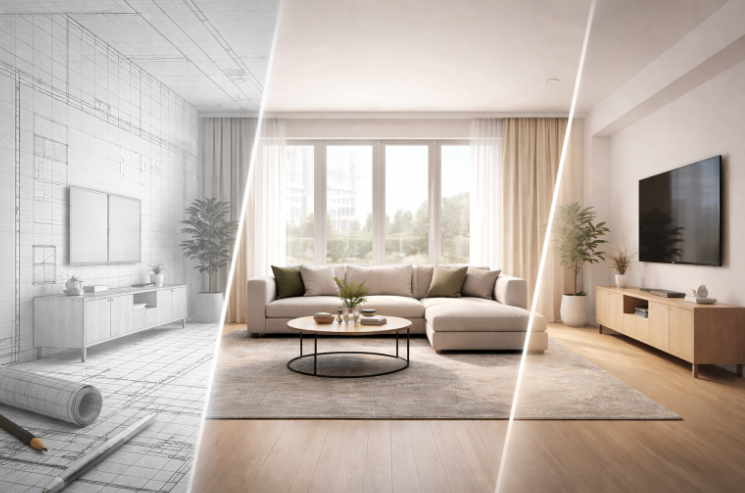
In the United States real estate market, digital presentation has become a technical requirement rather than a marketing add-on. According to the National Association of Realtors, 90% of U.S. homebuyers begin their property search online, making listing imagery the first evaluation layer for most buyers. This change has led brokers, developers, and listing teams to rely on visual tools that can be applied across multiple listings while still meeting U.S. disclosure rules and advertising requirements.
Within this landscape, professionals frequently compare virtual staging vs 3D rendering for real estate to decide how best to present a property. While both approaches aim to improve buyer understanding of space, they operate on very different technical foundations. The difference between virtual staging and 3D rendering lies in how the visuals are produced, the level of abstraction involved, and the type of property each method accurately represents. These distinctions influence cost, production timelines, and buyer trust.
Industry data referenced by the National Association of Realtors and the U.S. Census Bureau shows that listings with clear, high-quality visuals experience higher engagement and shorter marketing cycles. Choosing virtual staging or 3D rendering, which is better, depends on property status, listing purpose, and how closely visuals must reflect physical reality.
Also Read: Virtual Staging
Virtual Staging and 3D Rendering Explained
In U.S. real estate practice, virtual staging and 3D rendering are used at different points in a property’s lifecycle. They are not interchangeable, and the technical inputs behind each method shape how reliable the final image feels to a buyer.
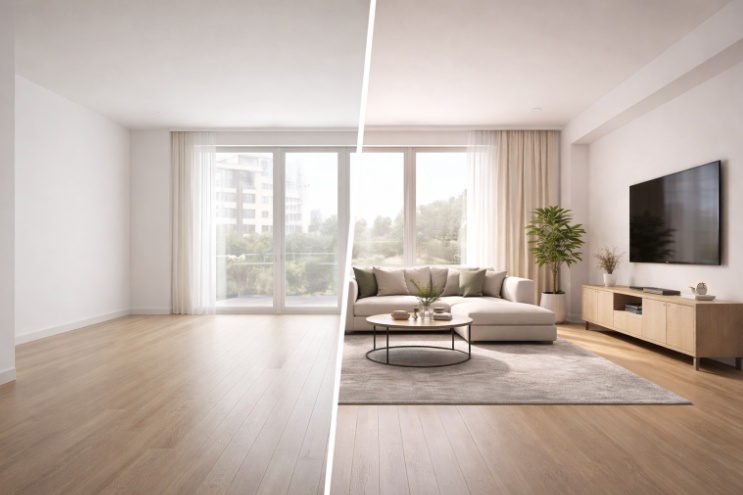
Virtual staging starts after a property exists in physical form. The base material is a real listing photograph, taken inside a finished space. Room proportions, ceiling height, window placement, and natural light are already fixed in the image. Digital furniture and decor are added within those limits. Scale is dictated by the photograph itself, not by design preference. Because of this constraint, virtual staging works within what the camera captured and cannot redefine the structure without crossing into misrepresentation. In virtual staging vs 3D rendering for real estate, this dependence on real photography is the defining technical factor.
3D rendering follows a different path. There is no camera and no finished room. The starting point is numerical data from architectural drawings, CAD layouts, or BIM models. Walls, openings, and lighting are constructed digitally before any image exists. Materials, finishes, and viewpoints are selected during modeling, not after. This approach allows visuals to be created before construction or during early development phases. The difference between virtual staging and 3D rendering lies in this origin point, not in visual polish.
Choosing virtual staging or 3D rendering, which is better, depends on whether the image needs to reflect an existing condition or communicate a planned one.
Also Read: Virtual Staging for MLS Listings: What to Know
How Each Technology Is Created: Workflow and Technical Process
Image Capture and Input Requirements
Virtual staging relies on completed listing photography. In the U.S., these images are usually taken once a property is fully accessible and prepared for marketing. Camera height, lens choice, and room framing matter because every staged element must align with what the photograph already shows. If the original image has distortion or poor lighting, staging accuracy drops immediately.
3D rendering does not depend on photography. The inputs are architectural drawings, CAD layouts, or BIM data. Visual quality depends on how detailed and accurate those files are, not on on-site conditions.
Spatial Reference and Scale Control
In virtual staging, scale comes from visual reference rather than measurement. Door frames, window sizing, and ceiling lines help set proportion. Furniture that ignores those signals appears unnatural to buyers.
In 3D rendering, scale is determined before any image is produced. Dimensions and clearances are fixed in the model, removing visual interpretation while relying fully on design specifications.
Also Read: How Much Does Virtual Staging Cost in the USA?
Lighting and Shadow Behavior
Virtual staging works within the lighting captured by the camera. Added shadows and highlights must follow the existing light direction and intensity. Inconsistent lighting is one of the fastest ways staged images lose realism.
Rendering handles lighting digitally. Sun angle, artificial fixtures, and reflections are configured before output, allowing flexibility but requiring more setup and testing.
Revision and Adjustment Process
Revisions in virtual staging are limited by design. Furniture replacements, minor layout changes, and color updates are typical, but the camera view and structure do not move.
3D rendering revisions can go deeper. Layouts, finishes, and viewpoints can be changed, though each adjustment adds time and production effort.
Output Constraints
Virtual staging produces static images tied to a specific photograph. 3D rendering can generate multiple views from the same model, provided the model was built with sufficient detail at the start.
Difference Between Virtual Staging and 3D Rendering
Input Source
The starting material is the clearest technical divider. Virtual staging depends on real listing photographs taken inside an existing property. Those images already contain fixed spatial and lighting information. By contrast, 3D rendering starts with design data such as architectural drawings, CAD layouts, or BIM files. There is no physical space captured by a camera at this stage, only measured inputs.
Also Read: What Are the Best Ceiling Color Ideas for the Living Room?
Relationship to Physical Reality
Virtual staging is anchored to a space that already exists. Wall placement, ceiling height, and window size reflect the actual property condition at the time of photography. Rendering represents an intended condition. The space shown may not exist yet or may still change during construction, which affects how buyers interpret accuracy.
Accuracy and Buyer Perception
Because virtual staging works within real photographs, buyers tend to read the space as trustworthy when scale and lighting are handled correctly. Rendered images feel more illustrative. They help explain layout and finishes, but buyers generally understand that the image represents a plan rather than a finished room.
Time and Production Effort
Virtual staging typically follows a shorter production cycle since it builds on completed photography. Rendering requires more setup time due to modeling, material definition, and lighting configuration before any image is produced.
Compliance and Disclosure
In U.S. listings, virtually staged images require disclosure because they modify real photographs. Rendered images are usually presented as conceptual visuals, which reduces disclosure complexity but limits their use in resale listings.
This difference between virtual staging and 3d rendering explains why virtual staging vs 3D rendering for real estate is less about visual quality and more about the condition of the property being marketed.
Also Read: Can I Pay Someone to Virtually Stage My Room
Virtual Staging vs 3D Rendering for Real Estate Use Cases
Existing Homes and Resale Listings
If a house already exists and buyers can walk through it, virtual staging fits the reality of the transaction. Photos come from the real space, and buyers compare them directly with what they see during showings. In U.S. resale markets, that consistency matters. Rendered images tend to feel detached in this context because buyers expect the listing photos to reflect what is actually there.
Vacant Properties
An empty room gives no scale cues. Buyers hesitate because they cannot tell how the furniture fits or how the space functions. Virtual staging adds those cues without changing the room itself. Since the home is available for inspection, the staged image does not replace reality. It just makes the listing easier to read.
New Construction and Pre-Sales
When a property is not finished, photography is not an option. Rendering fills that gap. Developers use it to show layouts, finishes, and spatial relationships before completion. Buyers treat these images as previews, not documentation, which changes how accuracy is judged.
Multi-Unit Developments
Large projects rely on repetition. Rendering allows the same model to represent multiple units, floor plans, or finish packages. Photography would require each unit to exist first, which is rarely practical at scale.
Misaligned Use Cases
Most issues come from forcing the wrong tool into the process. Renderings used for resale listings raise trust questions. Overstaged photos create expectation gaps. Nearly every mistake tied to virtual staging vs 3D rendering for real estate traces back to ignoring the property’s actual status.
Also Read: Does Virtual Staging Help Sell a House? A Clear Look at the Data
Conclusion
The decision between virtual staging and 3D rendering is shaped by how a property is being sold rather than how it looks. In U.S. real estate, buyers expect listing images to mirror the physical space, particularly for resale and MLS homes. Virtual staging aligns with this expectation by enhancing real photos while keeping proportions accurate. 3D rendering serves a separate purpose by presenting developments that are still in planning or construction. When the visual approach matches the property’s true state, it improves understanding. That fit protects buyer trust, speeds up decisions, and keeps marketing efforts focused.
Ready to Stage Smarter?
Deco’s virtual staging services help U.S. listings present real spaces clearly, accurately, and at scale. Turn empty photos into buyer-ready visuals without distorting reality or expectations.
FAQs
Is virtual staging actually allowed for resale listings in the United States?
Yes, it is used widely, but disclosure matters. MLS guidelines expect buyers to understand what is digitally altered. Staged images cannot change room size, remove permanent features, or present elements that do not exist when buyers visit in person.
Can virtual staging and 3D rendering be used within the same real estate project?
They can, when the situation calls for it. Renderings may explain future construction or planned renovations, while virtual staging helps buyers understand how existing rooms function today. The key is making it obvious which images show current conditions.
Do buyers react differently to 3D renderings compared to virtually staged photos?
Yes, and the difference shows quickly. Buyers treat renderings as illustrative, not literal. Virtually staged photos feel closer to reality because they start from real images, which makes proportion or layout issues easier to spot.
Ready to transform your listings?
Experience the power of AI-driven virtual staging with Deco.


